How the directory works
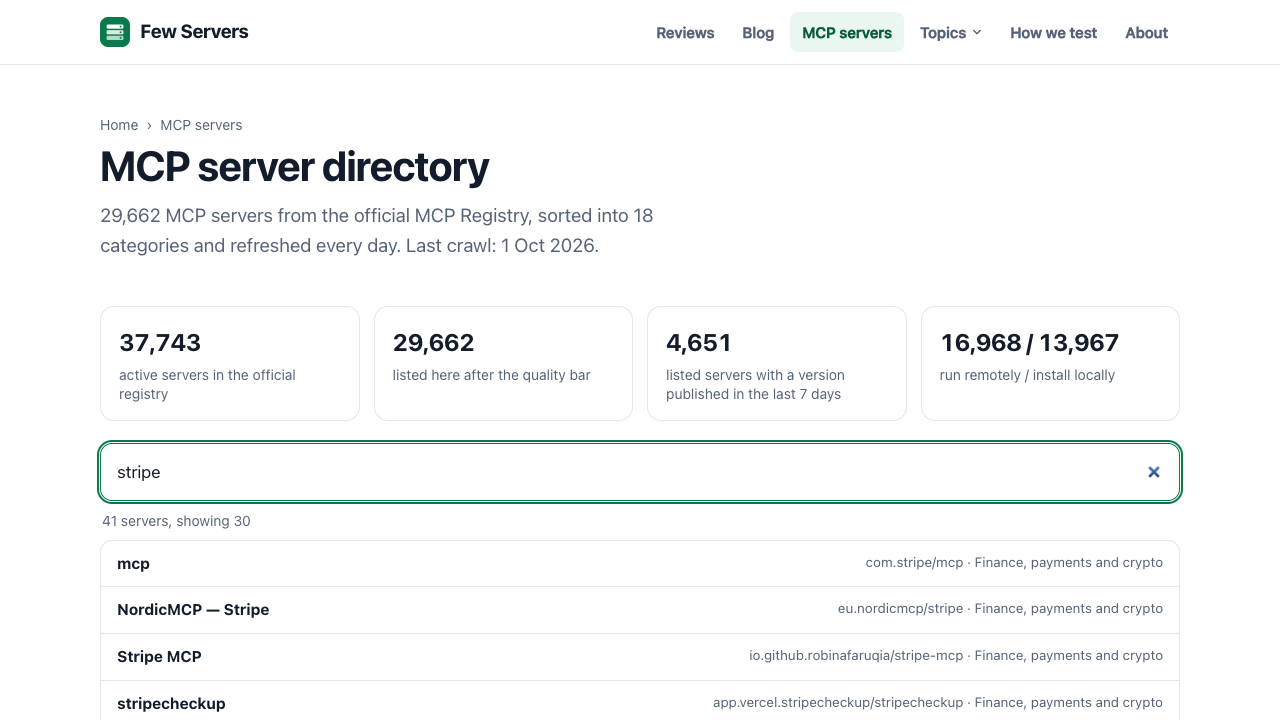
Once a day we read the public API of the official MCP Registry, which its maintainers describe as intended for downstream aggregators like this one. Every entry is sorted into a category by keyword rules on its name and description, and given a completeness score: a repository, an installable package, a title, a website and a real description add points; placeholder text, copy-pasted descriptions and publishers with hundreds of near-identical entries lose points. Entries below the bar are not listed.
The order of a list is that score, then the date of the last update. It is not a rating, and it says nothing about security. Servers marked Vendor are published under the namespace of the company whose product they connect to; the registry verifies namespace ownership through the publisher's domain or GitHub account. When we install and test a server ourselves, the entry links to the write-up.
Publisher of a server and something is wrong or missing? Write to hello@fewservers.com.
FAQ
What is an MCP server?
An MCP server is a program that gives an AI application access to tools and data through the Model Context Protocol, an open standard introduced by Anthropic in November 2024. The AI client, such as Claude, an IDE or an agent framework, connects to the server and can then call the tools it exposes, for example querying a database or creating an issue.
Where does this list come from?
From the official MCP Registry at registry.modelcontextprotocol.io, the metadata repository run by the MCP project. We read its public API once a day. On 2 Oct 2026 it held 37,842 active servers; 29,760 of them are listed here.
Why are some registry entries missing?
The registry is deliberately unopinionated and accepts any server with a verified namespace. We leave out entries that look empty or mass-produced: placeholder descriptions, identical text repeated across many entries, and publishers with hundreds of near-identical servers. Deprecated entries are left out too.
What is the difference between a remote and a local MCP server?
A remote server runs on the publisher's infrastructure and you connect to its URL, usually over streamable HTTP. A local server is a package you install and run yourself, from npm, PyPI, a Docker image or another package registry, and it talks to the client over standard input and output.
Are these servers safe to use?
Being listed is not a safety check. The registry verifies who owns a namespace, not what the code does, and we have only tested the servers that carry an "Our guide" link. Read the repository, check what permissions and credentials a server asks for, and prefer servers published by the vendor of the service they connect to.