Hands-on review. We paid for the plans we tested. Links marked as affiliate links earn us a commission at no cost to you; it never changes what we recommend. Details.
In part 1 we compared what the free plans include. This part answers the question that matters on a bad night: when something goes down, how long until the monitor knows? We took an app down on purpose, three times, and timed both monitors against the clock.
Tested 5 Oct 2026, 00:44 to 01:45 UTC: the target was a small sample app deployed with Coolify 4.3.23 on our DigitalOcean $6 droplet (1 vCPU, 1 GB RAM). Uptime Kuma 2.5.5 ran on the same droplet. UptimeRobot was a new free account. Better Stack was meant to be the third monitor, but its sign-up page said "Sign up is temporarily unavailable" on 5 Oct 2026, so it is not in this test.
How we ran the test
Both monitors watched the same URL with a plain HTTP check:
| Uptime Kuma | UptimeRobot free | |
|---|---|---|
| Where it runs | On our droplet, next to the app | UptimeRobot's servers; our checks came from North America (N. Virginia and Ashburn, USA) |
| Check interval | 20 seconds (we set it) | 5 minutes (the free plan's only option) |
| Retries before "down" | 0 | Left at the default |
| Alerts | None configured: we only read its log | E-mail to our inbox |
Then, from another machine over SSH, a script stopped the app's container with docker stop, waited 10 minutes, started it with docker start, and waited 10 more minutes before the next round. It wrote the exact time of every stop and start. Afterwards we read Uptime Kuma's heartbeat history from its database, and UptimeRobot's incident list and alert e-mails.
While the container was stopped, both monitors saw an HTTP 404 from Coolify's proxy rather than a timeout: the server and proxy stayed up, only the app was gone. That is the most common kind of outage on a small server (a crashed or redeploying app), and both monitors treated it as down.
Results
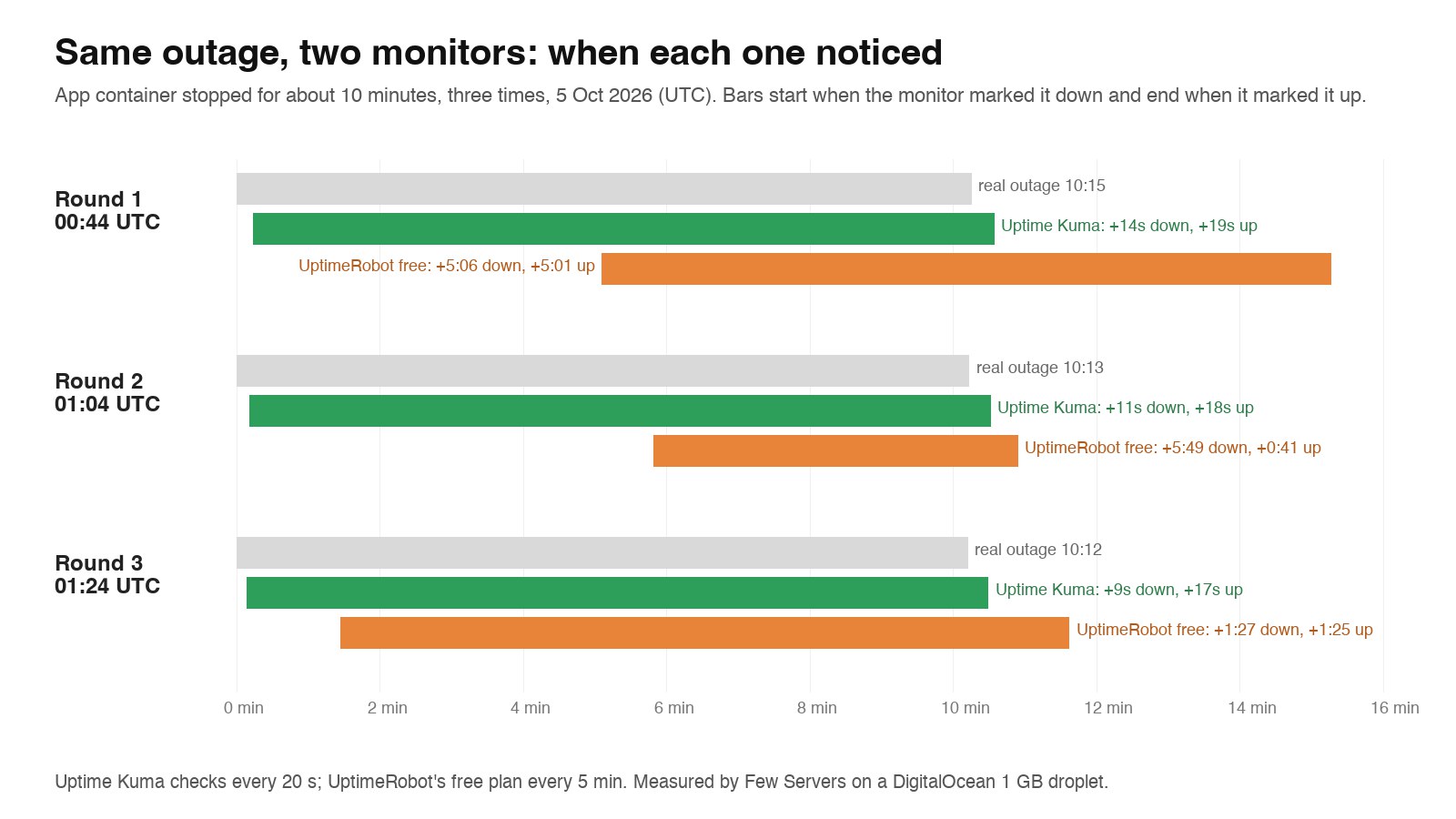
| Round (UTC) | Real outage | Uptime Kuma: down after | Uptime Kuma: up after | UptimeRobot: down after | UptimeRobot: up after | UptimeRobot logged |
|---|---|---|---|---|---|---|
| 1 (00:44) | 10 min 15 s | 14 s | 19 s | 5 min 6 s | 5 min 1 s | 10 min 10 s |
| 2 (01:04) | 10 min 13 s | 11 s | 18 s | 5 min 49 s | 41 s | 5 min 5 s |
| 3 (01:24) | 10 min 12 s | 9 s | 17 s | 1 min 27 s | 1 min 25 s | 10 min 10 s |
| Average | 11 s | 18 s | 4 min 7 s | 2 min 22 s |
"Down after" is the time from our docker stop to the moment each monitor marked the app down; "up after" is from docker start to the moment it marked it up. UptimeRobot's times are from its incident list, which matched the times in its e-mails within a second.
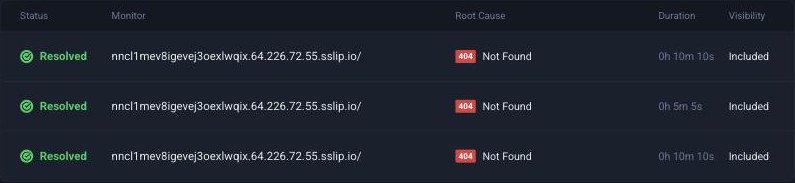
What the numbers say
Uptime Kuma noticed every outage within one check. With a 20-second interval, the worst case is about 20 seconds, and all three detections fell inside that. Recovery took one or two checks.
UptimeRobot's free plan is a lottery inside a 5-minute window. When the outage starts just before a check, it is caught fast (1 minute 27 seconds in round 3). When it starts just after one, you wait a full cycle or more (5 minutes 49 seconds in round 2). The average was just over 4 minutes.
Short outages get shortened, or missed. In round 2 UptimeRobot's first failing check came almost 6 minutes into a 10-minute outage, so its incident list says the outage lasted 5 minutes 5 seconds, half the real length. By the same arithmetic, an app that is down for 3 or 4 minutes can fall between two checks and never appear at all. We did not run a short outage, so we cannot say how often that happens; the 5-minute interval is what makes it possible.
The e-mails were prompt. Each DOWN and UP e-mail from UptimeRobot reached our inbox in the same minute as the incident start or end shown in its dashboard. The delay is the check interval, not the alerting.
UptimeRobot's alert e-mails say so themselves: the first one included a tip that "most website outages last less than 5 minutes" and offered 1-minute checks on a paid plan. On 2 Oct 2026 that was the Solo plan at $10 a month, or $9 billed annually, which checks every 60 seconds (part 1 has the full price table).
The catch with the fast one
Uptime Kuma's 11 seconds come with two conditions.
- It only knew; it told nobody. We did not set up a notification channel, so this test measured detection, not delivery. In real use, add one (e-mail, Slack, Telegram, a webhook) right after creating the admin account and send yourself a test alert.
- It lives on the same server. Our app went down, the server did not. If the droplet itself fails, or Coolify's proxy stops, Uptime Kuma fails with it and no alert is sent. We did not take the whole server down in this test; that limit follows from where the monitor runs.
What we would set up
- Uptime Kuma on your server for fast checks of every app and internal service, with a notification channel tested on day one.
- One free UptimeRobot monitor pointed at the server itself (or at Uptime Kuma's own address), so you still hear about it when the whole box is gone. Expect to hear within about 5 minutes, not seconds.
- Pay for 1-minute external checks only when a few minutes of silent downtime costs you more than about $9 a month.
If you want Uptime Kuma, part 1 covers the install on a 1 GB server, including its 2.49 GB image and the public setup page you need to claim straight away.
FAQ
How quickly does UptimeRobot's free plan detect downtime?
In our test, between 1 minute 27 seconds and 5 minutes 49 seconds, 4 minutes 7 seconds on average over three outages. The free plan checks every 5 minutes, so detection depends on where the outage falls in that cycle.
How quickly does Uptime Kuma detect downtime?
With a 20-second check interval, it marked the app down 9 to 14 seconds after we stopped it, in all three rounds. Detection time follows the interval you set.
Can UptimeRobot's free plan miss an outage?
It can shorten one: a 10-minute outage was logged as 5 minutes 5 seconds because the first failing check came late. An outage shorter than the 5-minute interval can fall between two checks. We did not test outages that short.
Did UptimeRobot's alert e-mails arrive late?
No. The DOWN and UP e-mails arrived in the same minute as the incident times shown in the dashboard. The wait comes from the check interval.
Is a self-hosted Uptime Kuma enough on its own?
Not if it runs on the server it watches. It caught every app outage in seconds, but it cannot report its own server going down. Pair it with one external check.
Used in this article
- UptimeRobotHosted uptime monitoring; free plan with 50 monitors at 5-minute checks.Visit UptimeRobot
Affiliate link: we may earn a commission if you sign up, at no cost to you. Details.